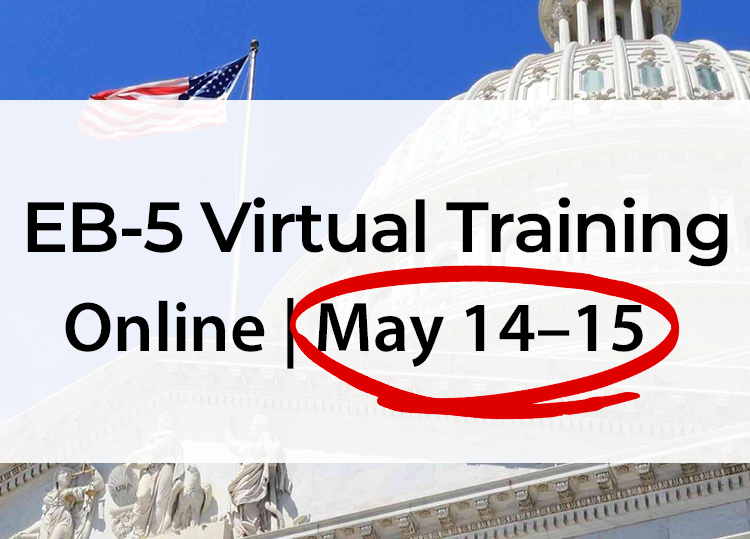
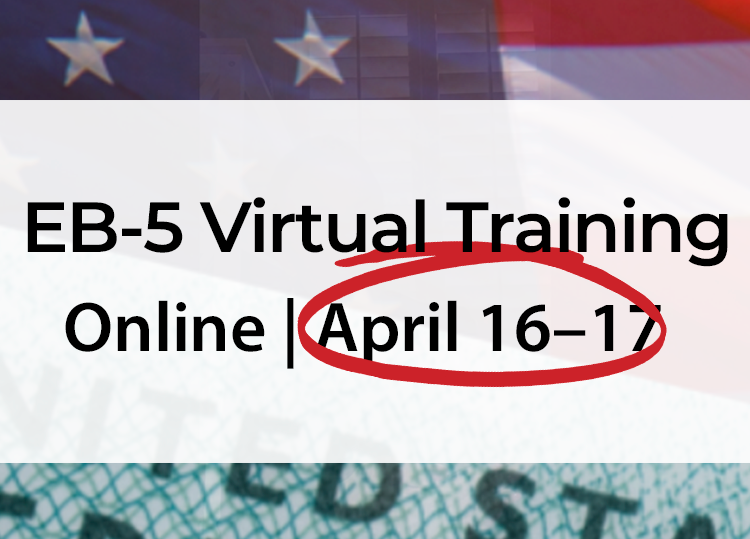
Welcome to our EB-5 Resource Hub! Here is your go-to destination for clear, reliable, and actionable information throughout your investment and immigration journey. Whether you're a prospective investor or an immigration professional, we offer curated content to help you make informed decisions with confidence.

EB-5 due diligence should include review of the project's offering documents, capital stack, developer equity, collateral, repayment terms, job creation methodology, construction or operating status, risk disclosures, conflicts of interest, and overall suitability for the investor.
No. USCIS regional center designation or project review does not mean the government has approved the investment as financially sound or low risk. The SEC and USCIS investor alert warns investors that a government designation should not be treated as an endorsement of investment quality.
Immigration attorneys generally handle the legal and immigration aspects of the case. Recommending a specific EB-5 investment can raise licensing, securities, ethics, and liability concerns if the attorney is not qualified or licensed to provide investment advice. A clearer approach is to connect the client with a licensed professional who can evaluate project options.
EB-5 project selection is the process of evaluating available EB-5 investment opportunities and helping an investor determine which project may be mostappropriate based on immigration goals, financial circumstances, risktolerance, timeline, and project structure.
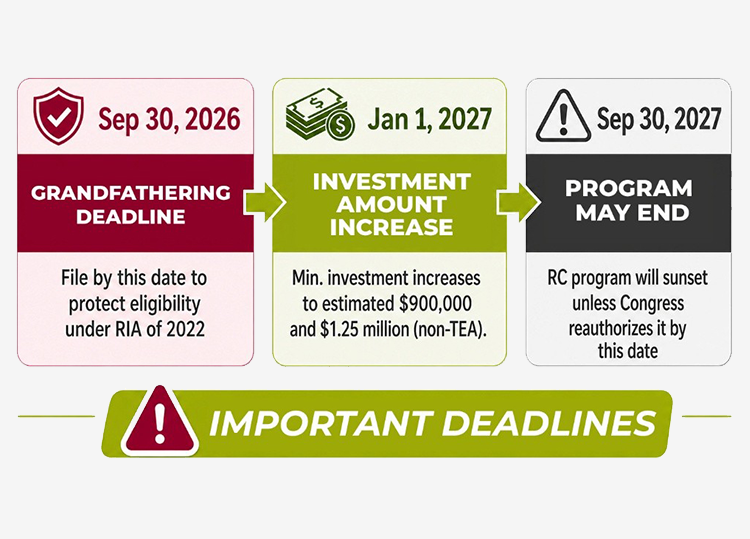
Now. Given the complexity of EB-5 filings and the importance of the 2026 deadline, early preparation is critical.
No. It guarantees that the petition will be adjudicated, but applicants must still meet all eligibility requirements.
The Regional Center Program is not permanent and has historically been extended through temporary legislation, requiring periodic congressional approval.
The EB-5 Regional Center Program is currently authorized through September 30, 2027. It must be reauthorized by Congress to continue beyond that date.
Petitions filed after this date are not protected by the grandfathering provision and may be affected if the EB-5 program is not reauthorized in 2027.
The EB-5 grandfathering deadline is September 30, 2026. Petitions filed on or before this date are protected and must be adjudicated even if the program later expires.
Schedule a consultation with an immigration attorney to determine if this program is right for you.
There are licensed financial professionals available to assist with EB-5 project selection. FINRA-regulated brokers perform independent due diligence on projects and assist investors through the process of selecting an EB-5 project.
The U.S. government does not guarantee the return of the funds. All EB-5 investments are private; investors are given a choice among many projects that they can choose to
invest in.
You can use funds earned in the United States for your investment.
Yes, gifts and loans are common sources of funds for EB-5 investors.
The Regional Center EB-5 program allows you to participate in a group of investors to provide capital to a larger project. The program does not require the investor’s day-to day management of the business.
The program has been extended since its implementation in 1992. However, it lapsed twice, most recently in 2021. Future extensions are possible, but are not guaranteed.
A FINRA-registered broker is a securities professional who operates through a registered broker-dealer and is authorized to offer or recommend securities within a regulated framework. When making recommendations to retail investors, broker-dealers are subject to the SEC’s Regulation Best Interest (Reg BI), which requires them to act in the investor’s best interest and not place their own financial interests ahead of the investor’s interests. Recommendations should take into account factors such as the investor’s financial circumstances, investment objectives, risk tolerance, and other relevant considerations.
FINRA oversees registered broker-dealers and their associated securities professionals, establishing and enforcing rules designed to promote fair dealing, transparency, and investor protection. This regulatory oversight differs from the role of an EB-5 regional center, which is primarily governed by immigration-related requirements and is not necessarily subject to FINRA broker-dealer supervision when presenting its own investment opportunities.
A FINRA-registered broker working with EB-5 investors can help evaluate investment opportunities, compare project structures, review offering materials, explain investment risks, assess whether an investment may be appropriate for the investor, and provide securities-related recommendations within the applicable regulatory framework. The broker does not replace the immigration attorney. Instead, the two roles complement each other: the immigration attorney addresses the legal and immigration aspects of the EB-5 process, while the broker assists the investor with the securities and investment side of the decision.
The 2022 Reform and Integrity Act (RIA) created numerous changes to the program, including:
Yes. Certain immediate family members can be included in the principal investor’s EB-5 case as derivative beneficiaries. This generally includes the investor’s spouse and unmarried children under the age of 21.
If the EB-5 case is approved and all immigration requirements are met, eligible family members may receive conditional permanent resident status together with the principal investor. Each family member must still complete the required immigration processing and remain eligible for permanent residence.
Parents, siblings, adult children, and other relatives are not automatically included in the investor’s EB-5 petition. They would need to qualify for U.S. immigration status through a separate immigration category.
Because a child’s age can affect eligibility, families with children approaching age 21 should discuss timing and Child Status Protection Act considerations with an experienced immigration attorney as early as possible.
We do not charge EB-5 investors hourly consultation fees. Our brokers are compensated by project sponsors through a pre-arranged broker-dealer agreement, which is typically covered partially by the project’s administrative fee. This means investors do not pay an additional fee to work with our brokers in our role as a registered representative. This compensation structure ensures investors can access licensed brokerage support without an additional upfront cost.
EB-5 immigrants may apply for the EB-5 program regardless of their immigration status or country of residency. U.S. residents with a current visa can undergo an “Adjustment of Status”, which transitions their current visa to an EB-5 visa. Residency and work authorization is maintained during this process.
Investors overseas can apply and undergo “consular processing” at a U.S. Consulate or Embassy. For foreign applicants, there are various opportunities for temporary residence in the U.S.
The timeframe for receiving your investment back varies based on the EB-5 project’s duration, the investment agreement terms, and the project’s overall performance. Most EB-5 offerings outline a projected schedule for project completion and job creation, and investors should note that all projections are subject to change. Investors should review all documents and consult professionals to understand the expected return timeline, including potential delays.
Repayment is not guaranteed and is governed by each project’s subscription and loan documents. In many offerings, capital becomes eligible for repayment after the loan term or stated exit strategy, but this timing is never guaranteed.
Under current rules, new EB-5 investors must keep their capital invested for at least two years, and the sustainment period may be longer depending on the project. All EB-5 investments involve risk, including possible loss of capital, and investors should thoroughly review offering documents and consult qualified professionals before proceeding.
EB-5 Support primarily offers project selection services for EB-5 investors looking for indirect/RC investment opportunities, which is over 95% of the EB-5 market. However, we can offer consulting services for direct investors looking to open their own business or with a partnered business looking to structure an offering.
EB-5 Support is headed by the Financial Regulatory Authority (FINRA) registered representative, Irina Rostova, who is registered as a broker regulated by the organization. FINRA offers a public service known as BrokerCheck, where the public can see a complete profile of all registered representatives. Likewise, Irina is a licensed immigration attorney with the Florida Bar Association.
EB-5 Support can also be found in the IIUSA member directory, the EB-5 Investors verified broker directory, and on the American Immigrant Investor Alliance website.
EB-5 Investors are required to comply with all U.S. entry requirements, show a lawful source for the EB-5 investment, and indirectly create ten jobs through their investment. Likewise, the full investment must remain in the EB-5 project for the entire loan period. Investors who can fulfill these requirements are good fits for the EB-5 program.
A qualified EB-5 project is one that meets the eligibility standards established by U.S. immigration law and is properly filed with U.S. Citizenship and Immigration Services (USCIS). To be considered compliant, a project must demonstrate:
- Job Creation
Each EB-5 investment must be structured to create at least ten full-time U.S. jobs per investor. For regional center projects, this can include direct, indirect, or induced jobs as supported by economic methodology.
- Comprehensive Documentation
The project must submit a detailed package to USCIS showing that it satisfies EB-5 program requirements. This includes but is not limited to a compliant business plan, economic impact report, capital structure documentation, and project-related agreements.
- Targeted Employment Areas (TEAs)
Projects located in a TEA (rural or high-unemployment area) qualify for the reduced minimum investment amount of $800,000. Standard, non-TEA projects require the standard $1,050,000 investment.
- At Risk Requirement
In order for an EB-5 investment to qualify, the EB-5 investor must place his or her capital at risk for the purpose of generating a return. U.S. Citizenship and Immigration Services (USCIS) requires that the capital be subject to potential gain or loss for the duration of the sustainment period.
Investors applying after 2022. Currently anywhere 1-3 years but temporary status is available to petitioners undergoing this process.
Selecting a suitable EB-5 project requires a strategic evaluation of each investor’s unique circumstances. Every client comes with distinct circumstances, immigration needs, financial objectives, family considerations, and risk tolerance.
Common Investor Profiles:
- Families with children nearing the age-out threshold and needing faster adjudication options.
- Internationals already in the U.S. on visas that do not lead to permanent residency, or who face long backlogs, do not meet education or employer-sponsorship requirements, or cannot qualify for achievement-based visa categories.
- Global investors who are seeking a balance between financial security, processing speed, and long-term residency planning.
Why the “Right Project” Varies by Investor:
Each petitioner’s case involves different priorities. Key considerations include:
- Risk tolerance.
- Investment experience and priorities.
- Liquidity needs.
- Immigration timelines.
- Current visa category and status.
- Country of origin and immigration trends.
- Available investment capital.
- Number of family members.
- Whether children are close to aging out.
- Expected processing time and travel plans.
- Long-term residency and financial goals.
Some investors prioritize speed, others prefer a more conservative structure with stronger financial backing, even if it may involve longer timelines.
Essential Factors to Evaluate in Every EB-5 Project:
- Construction timeline and feasibility.
- Capital stack composition: developer equity, EB-5 capital, senior and mezzanine financing.
- Asset type: hospitality, multifamily, healthcare, industrial, etc., and the associated risk profile.
- Job creation methodology and job creation cushion.
- Investment terms: loan maturity, exit strategy, extension rights.
- Developer’s experience and performance on similar asset classes.
- Regional center track record with compliance and successful adjudications.
- Downside scenario planning: such as the waterfall structure and who is repaid first, next, and last.
- Investor protections: review of agreements for rights, remedies, and safeguards in adverse scenarios.
No project can guarantee immigration or financial outcomes. A careful review and understanding of offering documents and risk disclosures is essential.
The Value of Working With a FINRA-Licensed EB-5 Broker-Dealer
Investors do not need to navigate the selection process alone. A licensed representative can:
- Compare EB-5 offerings across the market.
- Explain structural differences and risk drivers.
- Clarify terminology.
- Help align project selection with each investor’s immigration and investment objectives.
To start your EB-5 process, you should first meet with a qualified EB-5 Immigration attorney to determine whether you are a good candidate for the EB-5 visa. Once you have consulted an attorney and are prepared to work on the Source of Funds with your immigration attorney you may meet with an investment broker to find an appropriate EB-5 investment opportunity.
This process allows you to apply for lawful permanent resident status (Green Card) while you are in the United States. This means you can obtain a Green Card without needing to return to your home country for visa processing.
Advance Parole, also known as a "travel permit," enables you to re-enter the United States without obtaining a visa. A transportation company, such as an airline, can accept an Advance Parole document as proof of your authorization to travel to the U.S. It does not replace your passport, and you must have it before leaving the U.S. in most cases.
The capital stack refers to the layered structure of financing used in EB-5 projects. It includes different sources of funding such as senior debt (bank loans), mezzanine financing, developer equity, and EB-5 investor capital.
Each layer has a different level of risk and repayment priority. EB-5 capital is typically positioned in a middle-risk tier, above equity but below senior debt. Understanding the capital stack helps investors evaluate financial stability and repayment likelihood of a project.
EB-5 petitioners living in the U.S. with lawful status can file their adjustment of status (Form I-485) concurrently with their EB-5 petition (Form I-526E). This concurrent filing allows petitioners to remain in the U.S. while their I-526E petition is pending.
A conditional permanent resident receives a Green Card valid for two years. To remove the conditions, you must file a petition within the 90-day period before your conditional Green Card expires. EB-5 investors are admitted as conditional permanent residents for two years. To remove the conditions, investors must file Form I-829 within 90 days before the two-year anniversary of their conditional permanent resident status.
The Immigrant Investor Program, also known as the Regional Center Program, allocates EB-5 visas to participants who invest in commercial enterprises that promote economic growth.
The minimum investment is $800,000 for projects in rural areas, high unemployment areas, and infrastructure projects. The investment requirement is $1,050,000 for projects outside these categories. All investments must be at risk, meaning the return on investment cannot be guaranteed.
Approximately 10,000 EB-5 visas are issued annually to immigrants and their families whose investments create at least ten full-time jobs for U.S. workers.
Of these:
The Job Creation Model is an economic forecasting methodology used to estimate how EB-5 investments will generate employment opportunities in the United States. In Regional Center projects, jobs are not counted directly but are calculated using economic input-output models such as RIMS II or IMPLAN.
These models analyze construction spending, operational revenue, supplier demand, and consumer activity to estimate indirect and induced job creation. USCIS requires that each investor’s capital contributes to the creation of at least 10 full-time jobs, making this model a key factor in project approval and immigration success.
The Material Change Policy refers to USCIS regulations that require consistency between the information submitted in an EB-5 petition and the actual execution of the investment project. If significant changes occur after filing—such as changes in business structure, job creation model, project scope, or investment terms—the original petition may no longer remain valid.
This rule is designed to ensure that USCIS adjudicates petitions based on accurate and stable project information. Investors may be required to refile if material changes occur before approval, making due diligence and project stability extremely important in EB-5 planning.
A priority date backlog occurs when the number of EB-5 applicants exceeds the annual visa availability for a specific country. The priority date is established when USCIS receives the investor’s initial petition (Form I-526E).
If demand is high, investors must wait until their priority date becomes current before proceeding with final stages of the immigration process. Backlogs can significantly impact processing times and vary depending on country of birth and visa category.
An escrow structure in EB-5 investments refers to a secure financial arrangement where investor funds are held by a third-party escrow agent before being released to the project. This mechanism is designed to protect investors by ensuring funds are only deployed once specific conditions are met, such as USCIS receipt of the I-526E petition or project financing milestones.
Escrow agreements outline strict rules regarding fund release, refund conditions, and investor protections. While not required by USCIS, escrow structures are widely used in EB-5 projects to enhance transparency and reduce risk for investors.
Redeployment refers to the reinvestment of EB-5 capital after the initial project phase has been completed but before the investor has satisfied immigration requirements. USCIS allows funds to be redeployed into another qualifying project to maintain compliance with the “at-risk” requirement.
Redeployment must remain within safe investment categories and cannot eliminate risk entirely. Proper structuring is essential to ensure continued compliance while protecting investor capital throughout the immigration timeline.
Source of Funds Tracing is one of the most critical requirements in the EB-5 immigration process. It refers to the detailed documentation and verification of how an investor originally earned, accumulated, and transferred the capital used for the EB-5 investment. USCIS requires a complete financial trail that demonstrates the money was obtained legally and moved through legitimate channels.
This process often includes tax returns, employment records, business ownership documents, property sale agreements, inheritance documentation, dividend records, and bank statements showing the movement of funds over time. Even indirect transfers—such as gifts or loans—must be fully documented, including the original source of the gifted or borrowed funds.
A syndicated EB-5 investment refers to a structure where multiple foreign investors pool their capital into a single large-scale project. These projects are typically managed by a Regional Center or investment sponsor and are designed to meet job creation requirements through a collective investment model.
Syndication allows investors to participate in large developments such as hotels, infrastructure projects, commercial buildings, and residential complexes that would not be accessible individually. Each investor still must independently meet EB-5 requirements, but job creation is calculated at the project level.
The EB-5 Visa Allocation System determines how many immigrant visas are issued annually under the U.S. immigration quota system. Each country is subject to limits, and visas are distributed based on priority date and demand.
When demand exceeds supply, a backlog occurs, especially for high-demand countries. The system also includes reserved visa categories for rural and high-unemployment projects, which may provide faster processing opportunities for certain investors.
Our webinars, led by industry experts, offer valuable insights, while exclusive events connect you with influential figures in the EB-5 community. For those seeking clarity on EB-5 requirements, timelines, and procedures, our comprehensive FAQs section addresses common concerns. Additionally, our detailed EB-5 Glossary breaks down key concepts and terminology, ensuring you have a clear understanding of the process. Explore our resources today and take the next step toward your EB-5 success.
EB-5 support
Phone number
Address
This website is for informational purposes only and is not intended as an offer or solicitation with respect to the purchase or sale of any security. Alternative Investments are speculative and illiquid, and investors may lose some or all of their investment. Securities offered through Sequence Financial Specialists dba Invest America, member FINRA/SIPC. Invest America and EB-5 Support are separate and unaffiliated entities. Copyright © 2026 EB-5 Support. All rights reserved. Privacy Policy